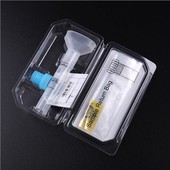
The eight-channel pipette is a device for quantitative conversion of liquids. It is widely used in biology, chemistry and other fields, as well as clinical diagnostic laboratories, biotechnology laboratories, pharmaceutical laboratories, environmental laboratories, and food laboratories. The commonly used tools are Manually adjustable pipettes and electric. There are also various optional specifications according to the volume of liquid to be transported.
The eight-channel pipette is easy to operate. Compared with glass pipettes, it can greatly improve the efficiency of inspection and detection, and is favored by experimenters; however, pipettes have always been used and easily managed. , Most laboratory inspectors use adjustable pipettes directly without training, and most laboratories inspect pipettes for one or half a year.
pipette
The following editor will explain to you the correct method of using the pipette and the precautions for use.
1. Correct use of eight-channel pipette
1. First of all, look at the position of the pipette marks and scale markings (Note: The volume of the pipette must be greater than or equal to the volume to be measured).
2. Wash the pipette, wash it with tap water or distilled water, and wait for the pipette to rinse.
3. Observe the arrangement of the pipette scale numbers, pay attention to whether the scale is from top to bottom or bottom to top, and find the 0 scale value.
4. Hold the suction ear ball in one hand, and the pipette in the other hand (hold the pipette with four fingers, and buckle the index finger on the top of the pipette)
5. Hold the ear-absorbing ball and put down the ear-absorbing ball, take the filter paper to wipe off the liquid stained on the outer wall of the pipette; pick up the reagent bottle, and require the reagent bottle to be at 45° with the table, and the pipette head should touch the bottle wall and be perpendicular to the table , Slowly relax the index finger to make the liquid level drop slowly to zero, and be careful not to make the liquid level drop too fast.
6. When moving to another container, it is also required to hold the container with one hand. The container is at an angle of 45° to the table. The pipette tip touches the wall and is vertical to the table.
7. After use, the pipette should be cleaned in time, and attention should be paid to avoid mixing and contaminating reagents.
2. Precautions for the use of eight-channel pipettes
1. Pipettes (pipettes) should not be dried in an oven.
2. The pipette (pipette) cannot pipette too hot or too cold solution.
3. The same pipette should be used as far as possible in the same experiment.
4. After the pipette is raised from the liquid surface, use filter paper to wipe off the liquid on the outer wall of the pipette.
5. When looking at the scale, the scale of the pipette should be parallel to the eyes, and the lowermost meniscus shall prevail.
6. After the pipette is used, it should be rinsed with tap water and distilled water immediately, and placed on the pipette rack.
7. Pipettes and volumetric flasks are often used together, so the relative volumes of the two are often calibrated before use.
8. When using a pipette for an eight-channel pipette, in order to reduce measurement errors, each time the uppermost scale (0 scale) should be used as the starting point, and the required volume of solution should be released downward, rather than the required volume. How much volume to draw.